Meet the Author | Marco Puleri
The sense of belonging of Russian speakers in Ukraine has been cause for much speculation in the media during the past years of the Ukraine crisis. In his latest publication “Ukrainian, Russophone and the Other Russian”, political scientist Marco Puleri analyses this phenomenon and shares his findings in a ZOiS interview. 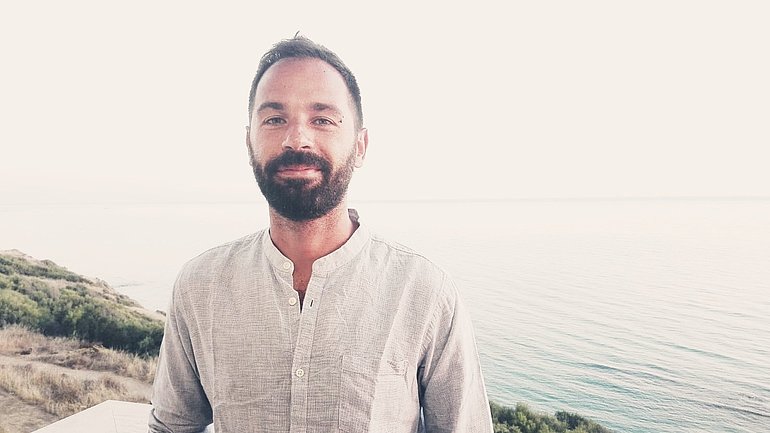 Marco Puleri
Your book is titled “Ukrainian, Russophone and the (Other) Russian”. What is the “other Russian”?
Through the political and cultural debates in Ukraine and Russia, it became quite clear that the identity of Russian speakers in Ukraine was subject of social and political appropriation. My idea for the book was to deconstruct the binary opposition of Ukrainian and Russian speakers. I did not want to portray Ukraine as a “divided” country. The Ukrainian crisis is really a process that started at the end of the Soviet Union in 1991. Russian speakers in various countries found themselves searching for new cultural and ideological affiliations. They represent the “Other Russian”. This term comes with a model of self-identification, which is based on a complex array of different backgrounds that cannot be appropriated – neither by the Russian Federation nor by the Ukrainian state or political discourse.
In the introduction, we learn that the term “Russophonia” has a difficult genesis. Could you tell us more about its development and history?
Nowadays, we face challenges to understand how Russian culture produced outside of the Russian federation differs from Russian culture produced inside the Russian federation. For example, we witnessed Vladimir Putin legitimising his political moves in Donbas and Crimea by the excuse of defending the “Russians” who live in these areas. Russophonia is a concept, which tries to understand Russian culture as a complex field made by different actors who work and live in different geographical areas, creating various distributions to Russian culture. Like Russian-speaking authors, who publish in Ukraine but contribute to the Russian culture through their language.
Large sections of the book use the lens of the postcolonial theory, which was created for critical dealing with Europe’s and America’s colonial history. Could you elaborate on the attempt to use the postcolonial theory in regard to the history of the post-Soviet states?
After the collapse of the Soviet Union, there was a long and very harsh debate among historians, sociologists and literature critics regarding the question, if it was possible to adapt the postcolonial methodology to the realm of the post-Soviet space. The problem is that Russia in this context is not comparable with the European colonialists of the pre-modern times. While one could describe the Ukrainian people as victims of the Soviet Union’s cultural policies, they were at the same time an active part of the Soviet establishment. Therefore, while we should not simply copy the approach, we can work with specific tools from the postcolonial theory. That is, why I chose to analyse the phenomenon of hybridity. Focusing on this aspect overcomes the strict binarism between Russian and Ukrainian culture.
To read the rest of the article, follow this link. https://www.zois-berlin.de/en/publications/the-identity-of-russian-speakers-in-ukraine-was-subject-of-social-and-political-appropriation

https://www2.cruzroja.es/-/ayuda-crisis-ucrania
 |
 |
 |
|
|